The top 10 features SONAR shipped this year
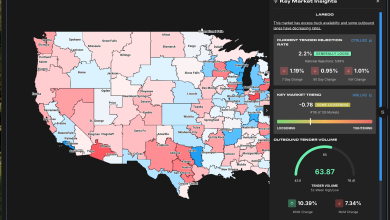
Enhancements include integrations, AI layers, new dashboards, better maps, and an iOS app.
China sets new port fees, could bar U.S. ships in retaliation for charges on Chinese shipping set to take effect in October.
Trump expands tariff powers, targeting imported metals and auto parts, while setting a 15% baseline on Japanese goods under a new trade deal.
p44 dips its toes in strategic planning, financial forecasting, and shipment execution.
US-EU trade deal cuts tariffs, boosts energy and digital trade, and aims to balance commerce by 2028.
Retail industry trade group forecast import volumes to finish this year 5.6% behind 2024 levels.
The decline of ocean container rates on the critical Asia-U.S. route is unstoppable amid President Trump’s economic war on China and reset of global trade policy, says analyst Xeneta.
The Trump administration’s tariff regime is generating heightened scrutiny from the Department of Justice.
Just in case ordering has diminished the truckload market’s utility, specifically for cross continental freight, but that mechanism may come undone later in the year.
Container imports surged to a multi-year high in early July, driven by importers racing to recover lost time after tariff disruptions. While volumes spiked, this early peak doesn’t necessarily signal stronger demand.. As inventories grow more expensive to hold, maritime carriers are bracing for softer demand and more volatile shipping patterns in the months ahead.
Surface transportation rates took a hard right to start the year, thanks to shifting supply chain strategies and a slowing economy. Is this just a pause or is there further to fall?
With the July 9 deadline for finalizing trade deals approaching, the Trump administration is advancing its global tariff strategy. This report outlines the latest developments in tariff implementations and ongoing negotiations with key trading partners. Details of U.S.-China Trade Deal High-level negotiations in London, concluded on June 10, 2025, have produced a framework agreement with […]
After months of back and forth, President Trump says a deal with China is done.
Uncertainty springing from erratic policy implementation in 2025 has made it challenging for businesses to make long-term commitments. That has kept the trucking sector from having its expected breakout moment this year.
Global leaders and trade stakeholders are reacting positively to a court ruling blocking tariffs imposed by President Donald Trump.
What happens now that a federal court striking down tariffs as “unconstitutional”?
Integrating multimodal transportation data with inventory data is key.
The 90-day tariff pause is likely to provide a bump to transportation rates as shippers take advantage of the new window.
The US and China have reached a landmark trade agreement, pausing reciprocal tariffs for 90 days and lowering duty rates to normal levels.
The Hobby Industry Coalition seeks targeted refinements to what it sees as crippling tariffs.
Penske, US Xpress, UPS, and more are in already planning workforce reductions.
CPKC CEO Keith Creel says the railroad, which reported higher revenue and profits for the first quarter, is “off to a strong start” for the year.
Apollo Global Management has a grim warning for the trucking industry: a recession is coming and mass layoffs will come with it.
Chinese sellers are now forced to play by the same rules as U.S.-based vendors.
Freight forwarders focused on the trans-Pacific are in pain.
Hong Kong is suspending postal service for packages destined for the United States as the trade war between China and the U.S. heats up.
Tariffs shmariffs. I wasn’t planning to stock up on Turkish delight or vanilla-flavored wine anyhow.
Border security is just as important to Trump as trade imbalances.
Mexico is dropping its plan to ban imports of genetically modified yellow corn from the U.S., officials say.
U.S. officials have called for a dispute panel over Mexico’s plan to stop importing genetically modified corn from farmers in the United States.
Two U.S. senators said Mexico’s plan to stop importing yellow corn violates its trade deal with the United States.
Atlas Air, Kalitta freighters spotted with military cargo at Air Force base
Fancy a Moscow mule or White Russian? Get ready to change brands.
High cost of repositioning reefer equipment is hitting food exporters hard amid ongoing tariff fallout.
The Trump administration’s reported plans to re-impose tariffs on aluminum imports from Canada could threaten cross-border supply chains. Or is it just a negotiating tactic?
Global trade could be the next casualty if the virus resurges, warns OECD.
Cargo flows face worst hit in a century but have potential to bounce back fast.
More tariff and sanction risks lie ahead for ocean shipping.
Trans-Pacific container volumes face escalating coronavirus risk.
FreightWaves’ maritime Market Expert Henry Byers provides insight regarding the Phase One trade deal between the United States and China.
New pact is a plus for tankers, bulkers and box ships, but less so for equities.
Phase One of the U.S.-China trade deal is scheduled to take effect Wednesday. Read CNBC’s Lori Ann LaRocco’s take on how that trade has changed since the tariff war began — and how it may never be quite the same.
A strong U.S. economy should see Europe-North America container volume growth of 3%+ next year, but clouds hover over the trade.
A trade war truce is not stopping multinationals from exploring alternative sourcing options to China, but moving supply chains is difficult, says expert.
Even a full U.S.-China trade deal might not stop shippers moving production out of China. But is the U.S. a realistic option?
Resilience360’s report on the impact of U.S.-China trade war discusses the uncertainty it has brought to global trade.
On Dec. 15, the same day Chinese tariffs were set to kick in on some U.S. goods, China agreed to suspend those levies, according to media reports. The suspension covers tariffs on products including corn and U.S.-made cars and auto parts, Reuters reported. The last-minute suspension came two days after the two countries agreed to […]
An exclusive interview with John Hadjipateras, founder and CEO of NYSE-listed Dorian LPG.
Trade tensions look like they’ll get worse before they get better, a negative for ocean shipping demand.
West Coast freight volumes have been robust in 2019, but empty rail containers signal that the balance is shifting east heading into 2020.
The shift of production from China to southeast Asia is unlikely to stop the trans-Pacific container market from declining this year.
CEO tells FreightWaves the U.S.-China trade war has transformed the trans-Pacific trade and customers are receptive to paying IMO 2020 bills.
A United Nations report concludes U.S. consumers and Chinese exporters are the primary losers in the trade war. Taiwan, Mexico, Europe and Vietnam are net beneficiaries.
Ben Thrower writes about the importance of American agriculture – not just to the U.S. population, but to the country’s trade negotiations.
September saw China record its lowest monthly export growth to the U.S. since 1996 as the trade war inflicted more damage.
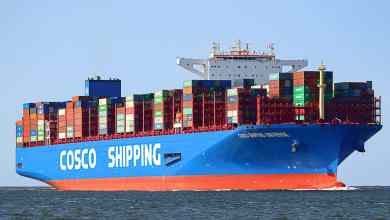
U.S. sanctions targeting a subsidiary of China’s COSCO Shipping could have far-reaching consequences.
Danish logistics conglomerate DSV is now one of the world’s leading forwarders after completing the acquisition of Panalpina in August.
Port of Los Angeles says it would take seven Vietnams to make up for the loss of business from China trade war.
Boeing Chairman and CEO Dennis Muilenburg on Wednesday expressed confidence the company would quickly overcome recent troubles with its new 737 MAX and 777X airplanes, but worried escalating trade tensions between the U.S. and China could undercut future sales of 767, 777 and 787 aircraft in its largest market. “The lack of a trade deal […]
It’s a great Monday to be alive, especially when it comes to listening to the hottest podcast in the freight industry. First, a massive cargo ship has capsized off the coast of Georgia, and some survivors have still not been rescued. Also, Uber Freight moves HQ to Chicago. Plus, we are visited by Kevin “King […]
Come on ride the ragin’ rollercoaster! First, Target tells suppliers to eat higher tariff-related costs, and Zach Strickland tells us why this has been one of the toughest freight cycles on record, and more.
The on-again, off-again trade war between the U.S. and China is a great threat to commercial vehicle forecasts, already buffeted by too many trucks and slowing freight growth.
The trade war with China has altered international shipping patterns, which has started to shift freight volumes to the East Coast.
Seaspan says high demand for containerships has shielded it from the U.S.-China trade war.
Stalco, a Toronto third-party logistics provider, takes advantage of duty-free limits to legally fulfill online orders of Chinese goods to consumers in the United States without incurring President Trump’s trade-war tariffs.
Escalations in trade tensions between the U.S. and China could discourage containership owners from ordering new ships.
Drewry says it expects a brief spike in transpacific freight rates to the U.S. West Coast following President Trumps threat to impose a new round of tariffs on imports from China.
On this historic WTT, Chad returns and joins Dooner on this odyssey of freight. We have breaking news about Trump’s new tariffs against China. Plus, K Ratio joins us to talk freight futures, JP returns to defend his earnings over/under title, and we celebrate our first-ever live stream on LinkedIn! Bang your little cowbell for […]
The new tariffs, announced a day after the Fed cut rates, will affect mostly consumer goods.
Flexport’s customers have seen average landed unit costs rise by 30 percent due to tariffs.
FedEx preaches patience and looking beyond FY2020’s results. It will be a tough sell.
The U.S. and China habve agreed to resume trade talks, a break in the nearly 2-month stalemate which has affected trade flows and spawned uncertainty among businesses
Top transportation economist Paul Bingham goes in-depth on trade war freight consequences, both pro and con.
It appears that Chinese retail investors are moving capital out of the country in response to the devaluation of the yuan.
Geopolitical and trade tensions are having an increasing effect on shipping rates.
Donald Broughton explains the harm that tariffs can do to the economies of the United States, the country(ies) that tariffs are imposed on and the global economy.
Market expert Henry Byers examines the U.S.-Chinese trade war and its impact on imports and the broader economy.
Trade war tariffs are hurting the competitiveness U.S. businesses working in China, according to the American Chamber of Commerce in China (AmCham China). Tariff troubles increased over the weekend as the latest round of Chinese tariffs on $60 billion of U.S. goods began on Saturday, June 1.
What The Truck?!? returns with its Backhaul weekend edition with a focus on the Mexican Trade War tariffs, On The Radar, Earning O/U and Fast Paced Forecast.
The logistics giant said it will “fully cooperate” with any investigation.
As U.S.-China trade tensions escalate, data appears to be pointing to a volume slowdown.
If a trade war pares GDP growth, OPEC cuts may be extended, weighing tanker rates.
FreightWaves CEO Craig Fuller says he hopes he is wrong, but data is showing the freight market is heading into a recession. Who will feel the impact and the facts and figures surrounding Fuller’s prediction.
Volumes took a nosedive after the tariffs increased and are starting to recover slightly, but the damage may already be done.
Sub: Removal of levies on aluminum and steel end costly trade dispute – but both nations reserve right to resume them in response to dumping.
Today on FreightWaves Now, we have snow in the Sierras and trouble in the midwest. Ports on both coasts prepare for another pull forward ahead of tariffs as the trade war rhetoric escalates.
What The Truck?!? hits the road this week as Chad and Dooner make tracks towards Birmingham, Alabama to cover McLeod’s Transportation, Finance and Accounting Conference. The guys talk with McLeod’s CEO Tom McLeod, VP of Ops David Custred, CFO Kasey Burleson, Chief InfoSec Officer Ben Barnes, and Buddy Moore Trucking’s CFO Susan Moore Kirkpatrick.
Danaos CEO does not believe trade dispute will cut box-ship ton-mile demand.
China’s new list more than doubles the tariff on LNG, but it’s the dry bulk stocks that are feeling the pain.
Stocks of publicly listed ship owners, particularly in the dry bulk sector, are feeling the fallout of trade tensions.
The final part of the FreightWaves series on the Panama Canal focuses on dry bulk transits. The two trends: US agribulk cargo to Asia is down, Colombian coal to the west coast of South America and Asia is up.
In the second-part of its series on the Panama Canal, FreightWaves interviews a canal authority executive on trends for container-ship transits and expectations for ship size growth in the years ahead.
A top executive of the Panama Canal Authority outlines the prospects for LNG, LPG and crude/product tanker transits through the larger locks of the waterway.
The annual deficit in goods and services increased by $68.8 billion, or 12.5 percent, according to Commerce Department data released today.
Talks between the U.S. and China have made significant progress over the last several weeks, and the two sides appear to be closer to a deal than at any time over the past several months. However, while the restoration of positive trade relations will help the trade outlook, other factors are likely to keep trade growth subdued going forward.