Breaking down Trump’s tariffs
Tariffs on the three largest trading partners of the U.S. will affect much of what Americans consume.
New tariffs pose a significant challenge for U.S. refiners, who are already grappling with declining profit margins.
Even cars assembled in the U.S. are not exempt from tariff shocks, as components from Mexico and Canada account for roughly 10% of the value of U.S.-built cars, with an additional 5% to 6% coming from Chinese inputs.
Mexico and Canada have announced agreements with President Donald Trump to delay tariffs on imports of goods from those countries for one month.
How bad can it get for cross-border?
Stock markets around the world saw sharp declines in response to President Trump’s imposition of tariffs and retaliatory actions by Canada and Mexico.
Canada and Mexico said they would impose tariffs on imports from the U.S. in retaliation for duties announced by President Trump on Saturday.
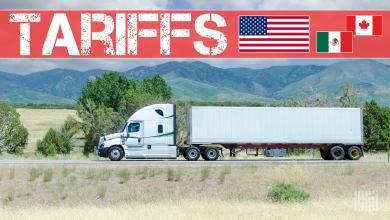
Trump imposes tariffs on imports from Canada, China, Mexico, impacting a wide range of raw materials and consumer goods.
In this edition: Still waiting on possible tariff implications, and Lunar New Year creates delays.
Trans-Pacific container rates eased in the most recent week as Chinese manufacturing and logistics activity wound down for the Lunar New Year holiday, which began Wednesday. Asia-U.S. West Coast ocean rates fell 7% to $4,938 per forty-foot equivalent unit for the week ending Jan. 24, according to the Freightos Baltic Dry Index. Asia-U.S. East Coast […]
Shippers and logistics professionals are bracing for U.S. tariffs on Mexican and Canadian imports that could begin Saturday.
US avoids trade war with Colombia after the two countries came to an agreement late Sunday over migrant deportations.
This week in Borderlands: Trump tariffs could raise consumer prices in short term, expert says; TransPak expands logistics operation in Texas; Logisticus Group opens supply chain facility near Phoenix; and Grupo Lintel plans $83 million logistics park in central Mexico.
President Trump said he was considering Feb. 1 as a start date for tariffs against Canada and Mexico, directing federal agencies to assess compliance with recent trade agreements.
President Donald Trump on Monday repeated his wish to “take back” the Panama Canal and initiate 25% tariffs against Mexico and Canada.
The Trump administration plans to end the expedited entry clearance benefit for parcels valued below $800, targeting Chinese e-commerce platforms but also impacting small U.S. importers.
President-elect Donald Trump’s tariff policies could weaken relations with Canada and Mexico, according to a recent panel discussion hosted by the Washington-based Wilson Center.
SCHAUMBURG, Ill. — The question of the day, on the first day of the Midwest Association of Rail Shippers Winter Meeting, is probably one being asked in one form or another at every business in the United States — or that does business with the U.S. What about tariffs? The consensus Wednesday was, not surprisingly, […]
U.S.-Mexico trade hit $69.2 billion in November as shippers frontload freight ahead of President-elect Donald Trump’s promised tariffs.
This week in Borderlands: US apparel importers scrambling after Mexico imposes tariffs; Source Logistics opens warehouse in Laredo; brokerage giant opens office in Fort Worth; and industrial manufacturer plans Fort Worth distribution hub.
A compromise by the ILA and USMX on automation has settled global concerns over a potential strike at U.S. East and Gulf Coast ports.
After a year marked by port congestion, vessel diversions and longshore labor issues, maritime shipping is bracing for the unknown in 2025.
Shippers continue to navigate the known and the unknown as trans-Pacific container rates moved higher as 2024 comes to an end.
The year’s five biggest U.S.-Mexico cross-border supply chain stories include projections that trade will top $800 billion and threats by President-elect Donald Trump to impose tariffs.
New policy could accelerate nearshoring trend.
Current forecasts indicate a significant escalation in tariff levels, potentially rising to an imposing 75% on Mexican goods by September 2026, aligning with a strategic pivot toward a protectionist trade policy.
Cross-border trade flows for industries such as autos, lumber and agrifoods could be affected by President-elect Donald Trump’s proposed tariffs, experts said.
New tariffs by the Trump administration on products from China, Canada and Mexico will hit companies and consumers with increased costs, experts said.
Ocean container rates to the U.S. remained steady as shippers maneuver to minimize the effects of higher tariffs and a potential port strike in 2025.
Container rates to the U.S. West and East coasts stayed above $5,000 per FEU as tariff talk and labor issues shadowed shippers’ plans.
President-elect Donald Trump’s plans to impose 25% tariffs on goods imported from Mexico and Canada could have a chilling impact on cross-border rail traffic, which has been one of the few sources of volume growth for North American Class I railroads.
Trump plans for tariffs on all imports from Canada, China and Mexico starting Jan. 20.
High tariffs on Chinese imports, promised by President-elect Trump, will likely slow U.S. trade in 2025 as uncertainty hinders investment in reshoring of manufacturing, a trade analyst predicts.
Blanket tariffs, like any other tax, may include certain exemptions. It is these exemptions — not the tariffs themselves — that are the real tool.
If China retaliates against tariffs on exports to the U.S. with its own tariffs, it could increase prices for Chinese consumers.
While imposing tariffs in the past has done damage to the U.S. economy, today’s incoming tariffs are likely to have a different outcome for a multitude of reasons.
Consumers are concerned that imposing tariffs means retailers will raise the price of goods. But retailers are likely to look for other sourcing options and new strategies.
China isn’t about to let its export market go belly-up. Instead, it will do what it always does – pump money into its industries to soften the blow of U.S. tariffs.
Donald Trump’s election victory has huge implications for U.S. trade and tax policies, climate change, the war in Ukraine, electric vehicles, and illegal immigration. Here is a summary of policies he has said he will pursue in his second term.
COVID-19, a shift in China’s main focus, an imbalance in U.S. trade with China and more all mean reassessing how nations engage with global trade.
For months now, it has been clear that shippers have frontloaded record imports to the country, largely to avoid expected tariffs.
President-elect Donald Trump’s campaign focused heavily on tariffs against China. Now that he’s won, tariffs are getting a lot of attention. But the issue has more than economic implications. It is about national security.
Importers with the National Retail Federation fear a second Trump administration could hurt business with higher tariffs on consumer goods.
This week in Borderlands: Gulf Coast ports slam US tariffs on Chinese container cranes; Volkswagen inaugurates $114M Gulf Coast shipping hub in Texas; Southeastern Freight Line launches direct route to New Mexico; and Warehouse On Wheels opens location in Mexico.
Presidential nominee Donald Trump calls for 200% tariffs on John Deere tractors if the company moves more jobs to Mexico.
A new White House effort to reduce the amount of online orders from China that enter the country duty free isn’t likely to interrupt the Shein and Temu business, but could have ramifications for U.S. consumers and retailers.
Canada is launching a 100% tariff on imports of electric vehicles made in China, citing unfair competition that it says threatens the global EV market.
China-based companies continue to ship more goods to the U.S. through countries like Thailand and Mexico to circumvent steep tariffs, say U.S. manufacturers and lawmakers.
U.S. officials announced a delay on the start of new tariff increases on Chinese imports, including a 25% tariff on China-made ship-to-shore cranes.
Port Houston saw a surge in container exports in June, while crude oil exports rose at the Port of Corpus Christi.
Direct-to-consumer tech provider ESW is partnering with UPS to offer e-commerce brands quicker access to cross-border shipments.
The ports of Los Angeles and Long Beach are turning to heavy-handed tactics to address a container logjam that is gumming up supply chains.
FlavorCloud has secured $6.3 million in funding to help expand its global presence as it works to build a seamless global e-commerce logistics network.
Andrew Cox explores how tariffs and trade policies can impact the retail landscape in the United States.
Gina Raimondo will be the anti-Wilbur Ross as secretary of commerce, with less focus on protectionism.
A look back at the days after the 2016 presidential election and the strange case of “The Donald Trump Shipping Stock Boom.”
High cost of repositioning reefer equipment is hitting food exporters hard amid ongoing tariff fallout.
Cargo mix and larger locks kept Panama Canal volumes rising despite headwinds.
“China and tariffs: Why COVID has actually increased cargo yields” was the topic of a virtual fireside chat at the American Shipper Global Trade Tech Summit.
Some U.S. importers worry the Trump administration’s actions could lead to new tariffs or other restrictions.
U.S. importers turn to Chinese sellers in the wake of COVID.
Commercial fishing is big business in Alaska. And like all industries, it depends on supply chains to work properly…
Although “Containers Don’t Lie,” the story they are telling may not reveal the entire picture.
Chattanooga-based Tranco Global brings customs expertise in house.
Production of most Christmas lights has moved Cambodia and other Asian countries from China.
United Airlines continues to build more of its fleet around Airbus aircraft with an order for 50 narrow-body A321s.
Preliminary orders for new Class 8 trucks tumbled again in November after one month of improved bookings, new evidence that a slowing manufacturing economy is sapping all but critical replacement demand.
Trade tensions look like they’ll get worse before they get better, a negative for ocean shipping demand.
An Office of the U.S. Trade Representative investigation concludes that a French tax on digital services discriminates against U.S. companies, such as Google, Apple, Facebook and Amazon.
China’s exports to the U.S. contracted last month. Even so, slowing U.S. exports to its trade rival saw China’s trade surplus with the U.S. widen.
Enterprise supply chain solutions provider LLamasoft has introduced a new taxes and duties analytics service on its platform, which will help companies navigate the complex environment of fluctuating global tariffs while optimizing strategic decisions.
Truck parking is not only a safety issue, but also an issue of driver rest. Reliance Partners, along with TruckPark, is exploring how truck parking reservation systems could help drivers get better rest and improve roadway safety.
Commerce secretary says talks on foreign automaker investment in the U.S. may again delay imposition of tariffs on imported vehicles.
American Airlines [NYSE: AAL] won’t have to make any major fleet decisions for at least six years after completing a $30 billion, multiyear modernization program, positioning American to significantly increase free cash flow and returns to shareholders, according to company executives. Since 2013, the Dallas-based airline has replaced nearly 500 aircraft and now has about […]
September saw China record its lowest monthly export growth to the U.S. since 1996 as the trade war inflicted more damage.
Large aircraft are included on the list of $7.5 billion worth of European imports that will be subject to new U.S. tariffs starting Oct. 18. That means U.S. airlines with orders for Airbus aircraft could pay more than expected. During Thursday’s (Oct. 10) earnings call with analysts, Delta Airlines [NYSE: DAL] CEO Ed Bastian expressed […]
At the center of the Trade War between the U.S. and China are the American ocean ports.
VLCC rates are now at or near $100,000 per day, courtesy of U.S. sanctions targeting China’s COSCO.
The transfer of production out of China to avoid U.S. tariffs of up to 25% is having a tangible impact on global trade flows.
U.S. sanctions targeting a subsidiary of China’s COSCO Shipping could have far-reaching consequences.
Flexport’s head of airfreight believes a small bump in demand out of Asia could result from new U.S. tariffs, while higher fuel prices will push up air cargo costs.
Borderlands is a weekly rundown of developments in the world of United States-Mexico cross-border trucking and trade. This week: San Antonio secures $1.2B deal with manufacturers; United States ends Mexican tomato investigation; Otay Mesa adds industrial park along US-Mexico border; CBP seizes $1M worth of drugs at the Pharr International Bridge. Proximity to Mexico helps San […]
BIMCO says there are “several indications” that goods are being shipped from the Far East to Europe and then transshipped to the U.S. East Coast to avoid tariffs.
President Trump announced that the U.S. will delay the next round of scheduled tariff increases.
The announcement comes after Beijing announced its first round of tariff exemptions for U.S. goods earlier in the day.
Come on ride the ragin’ rollercoaster! First, Target tells suppliers to eat higher tariff-related costs, and Zach Strickland tells us why this has been one of the toughest freight cycles on record, and more.
The U.S. Department of Commerce recently issued 31% tariffs on structural steel imports from Mexico and 141% tariffs on steel from China. U.S. officials made a determination that producers in both Mexico and China had dumped fabricated structural steel on the U.S. market at prices below fair market value, hurting the U.S. steel industry. “The […]
How tariffs played a role in Amazon deforestation.
How Flexport is managing the challenges of todays air cargo environment
The trade war with China has altered international shipping patterns, which has started to shift freight volumes to the East Coast.
Asia-U.S. container rates are still not showing peak-season strength, but optimism remains.
Can listed shipping shares break out of their slump before the U.S.-China trade dispute is resolved?
North Asia revenues were down 8.5 percent, but EXPD improved productivity.
ISM data in both the service sector and manufacturing sector suggest the economy is slowing and recent tariffs could make things worse